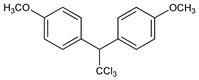
5990. Methoxychlor
Nomenclature
CAS number: 72-43-5
1,1′-(2,2,2-Trichloroethylidene)bis[4-methoxybenzene]; 1,1,1-trichloro-2,2-bis(p-methoxyphenyl)ethane; 2,2-di-p-anisyl-1,1,1-trichloroethane; DMDT; methoxy-DDT; Marlate (DuPont). C16H15Cl3O2; mol wt 345.65.
C 55.60%, H 4.37%, Cl 30.77%, O 9.26%.
Description and references
Commercial prepn by the condensation of anisole with chloral in the presence of sulfuric acid: Schneller, Smith, Ind. Eng. Chem. 41, 1027 (1949). Activity: P. Luger et al., Helv. Chim. Acta 27, 892 (1944). Toxicity study: H. C. Hodge et al., J. Pharmacol. Exp. Ther. 99, 140 (1950). Review of toxicology and human exposure: Toxicological Profile for Methoxychlor (PB2003-100140, 2002) 290 pp.