Description and references
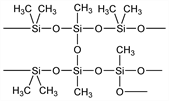
Polymeric methyl silicon oxides, probably of
a cross-linked siloxane structure: Rochow, Gilliam, J. Am. Chem. Soc. 63, 798 (1941).
Prepd by hydrolyzing dimethyldichlorosilane or its esters followed
by oxidation with air and a catalyst to the desired CH3/Si ratio: Hyde, DeLong, ibid. 1194; by hydrolysis of
dimethyldichlorosilane mixed with methyltrichlorosilane or silicon
tetrachloride followed by cocondensation of the products: Rochow,
Gilliam, loc. cit.; by partially methylating silicon tetrachloride
to the desired CH3/Si ratio and hydrolyzing the reaction
mixture: US 2258218 (1941).
Properties
Characterized by excellent thermal stability and
good resistance to oxidation. Oxidize slowly in air at 300° to silica.
Can be heated to 550° in vacuo or to 500° in hydrogen
without dec or melting. CH3/Si = 1.2. Solid. d 1.20. nD20 1.425. Hardens in 2 hours at 100°. CH3/Si = 1.3. Solid. d 1.15. nD20 1.422. Hardens in 1.5 hours at 120°. CH3/Si = 1.4.
Solid. d 1.08. nD20 1.421. Hardens in 4 hours at 141°. CH3/Si = 1.5. Solid. d 1.06. nD20 1.418. Hardens in 24 hours at 100°. CH3/Si <1.2. Sticky syrups. Harden at room temp. CH3/Si >1.5. Oily liquids. Set to a soft gel after several
days or weeks at 200°.Use
In electrical insulation; in heat-resistant paints
and varnishes; in protective and decorative finishes.