6607. Nitroglycerin
Nomenclature
Description and references
Nitric oxide donor that induces vasodilation. Prepn: Sobrero, Ann. 64, 398 (1847); Williamson, Ann. 92, 305 (1854). Review of the early literature: J. W. Lawrie, Glycerol and the Glycols (New York, 1928). Review of chemistry and biochemistry: F. J. DiCarlo, Drug Metab. Rev. 4, 1-38 (1975). Review of mechanism of action: S. F. Vatner, G. R. Heyndrickx, Handb. Exp. Pharmakol. 40, 131-161 (1975). Molecular mechanism of nitric oxide release: Z. Chen et al., Proc. Natl. Acad. Sci. USA 99, 8306 (2002). Review of the first hundred years: J. R. Parratt, J. Pharm. Pharmacol. 31, 801-809 (1979). Comprehensive description: E. F. McNiff et al., Anal. Profiles Drug Subs. 9, 519-541 (1980). Symposium on nitroglycerin therapy, perspectives and mechanisms: Am. J. Med. 74, no. 6B, 1-94 (1983). Review of pharmacology and clinical studies of intravenous administration in heart disease: E. M. Sorkin et al., Drugs 27, 45 (1984). Clinical trial in treatment of anal fissures: J. H. Scholefield et al., Gut 52, 264 (2005).
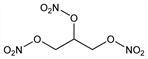
Properties
Pale yellow, oily liquid. Sweet burning taste. Produces headache on tasting. Explosive; poisonous. Crystallizes in 2 forms: labile form, mp 2.8°; stable form, mp 13.5°. d1515 1.599; d44 1.6144; d415 1.6009; d425 1.5918. nD15 1.474. Begins to dec at 50-60°, appreciably volatile at 100°, evolves nitrous yellow vapors at 135°, explodes at 218°. Vapor pressure at 20°: 0.00026 mm; at 93°: 0.31 mm. One gram dissolves in 800 ml water, in 4 g ethanol, in 18 g methanol, in 120 g carbon disulfide. Misc with ether, acetone, glacial acetic acid, ethyl acetate, benzene, nitrobenzene, pyridine, chloroform, ethylene bromide, dichloroethylene. Sparingly sol in petr ether, liquid petrolatum, glycerol. Heat of combustion: 1580 cal/g. Explodes on rapid heating or on concussion. On explosion harmless gases are produced: 4C3H5(ONO2)3 → 12CO2 + 10H2O + 6N2 + O2.Derivative
Spirit of Glyceryl Trinitrate.Nomenclature
Spirit of nitroglycerin; spirit of glonoin.Description and references
An alcoholic soln contg 1.0-1.1% glyceryl trinitrate.
Properties
Colorless, clear liquid. d 0.814-0.820. Miscible with alcohol, chloroform, ether; 1 ml dissolves in 6 ml almond oil; very slightly sol in water; miscible with chloroform, ether.Caution
Potential symptoms of overexposure by percutaneous or respiratory absorption are throbbing headache, dizziness, nausea, vomiting, abdominal pain; hypotension; flushing; palpitations; methemoglobinemia; delerium, CNS depression; angina; cyanosis; coma. Direct contact may cause skin irritation. See NIOSH Pocket Guide to Chemical Hazards (DHHS/NIOSH 97-140, 1997) p 228; Patty's Industrial Hygiene and Toxicology vol. 2B, G. D. Clayton, F. E. Clayton, Eds. (Wiley-Interscience, New York, 4th ed., 1994) pp 1064-1067.Use
Manuf of dynamite (75% nitroglycerol, 24.5% diatomaceous earth, 0.5% sodium carbonate), smokeless powders and blasting gelatin; in rocket propellants.Therapeutic Category
Antianginal; vasodilator (coronary). Topically in treatment of anal fissures.
Therapeutic Category (Veterinary)
Topical vasodilator (coronary); antianginal.Keywords
Antianginal; Vasodilator (Coronary)