6733. Nylon
Nomenclature
Polyamide.Description and references
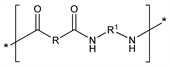
Generic term used to describe “a manufactured fiber in which fiber-forming substances are any long-chain synthetic polyamide having recurring polyamide groups (‐CONH‐) as an integral part of the polymer chain”. Formed from various combinations of diacids, diamines, and amino acids. May be formed also by addition polymerization. The linear polyamides have achieved the greatest commercial success. Shorthand nomenclature of nylons involves the use of numbers: a single numeral indicating the number of carbon atoms in a monomer, e.g. nylon 6; two numbers indicating a polymer formed from diamines and dibasic acids, the first numeral indicating the number of carbon atoms separating the nitrogen atoms of the diamine, the second indicating the number of straight-chain carbon atoms in the dibasic acid, e.g. nylon 6,6. First produced by E. I. du Pont de Nemours & Co. according to patents of W. H. Carothers. The name nylon was dedicated to public domain on Oct. 27, 1938 at the Herald Tribune Forum where the product itself was announced. Reviews: R. W. Moncrieff, Man-Made Fibres (John Wiley, New York, 1963) pp 335-355; Snider, Richardson, “Polyamide Fibers” in Encyclopedia of Polymer Science and Technology vol. 10 (Interscience, New York, 1969) pp 347-460; J. H. Saunders, “Polyamides (Fibers)” in Kirk-Othmer Encyclopedia of Chemical Technology vol. 18 (Wiley-Interscience, New York, 3rd ed., 1982) pp 372-405. Book: Nylon Plastics, M. I. Kohan, Ed. (Wiley-Interscience, New York, 1973).