6740. Ochratoxins

Description and references

Toxic metabolites from Aspergillus ochraceus Wilh.: Scott, Mycopathol. Mycol. Appl. 25, 213 (1965); A. sulphureus and A. melleus: Lai et al., Appl. Microbiol. 19, 542 (1970); and Penicillium viridicatum Westling: van Walbeek et al., Can. J. Microbiol. 15, 1281 (1969). As these molds occur widely, some toxins have been found as natural contaminants on corn, peanuts, storage grains, cottonseed and other decaying vegetation. Isolns: van Walbeek et al., ibid. 14, 131 (1968); Shotwell et al., Appl. Microbiol. 17, 765 (1969); Nesheim, J. Assoc. Off. Anal. Chem. 52, 975 (1969); Natori et al., Chem. Pharm. Bull. 18, 2259 (1970). Structure and stereochemistry: van der Merwe et al., J. Chem. Soc. 1965, 7083; Nature 205, 1112 (1965). Synthesis of ochratoxins A, B and ester deriv: Steyn, Holzapfel, Tetrahedron 23, 4449 (1967); Nesheim, loc. cit.; Roberts, Woolven, J. Chem. Soc. C 1970, 278. Facile synthesis of A: G. A. Kraus, J. Org. Chem. 46, 201 (1981). Toxicity study: Purchase, Theron, Food Cosmet. Toxicol. 6, 479 (1968). Physicochemical data: A. E. Pohland et al., Pure Appl. Chem. 54, 2220 (1982). Comprehensive reviews: Steyn, “Ochratoxin and other Dihydroisocoumarins” in Microbial Toxins vol. VI, A. Ciegler, et al., Eds. (Academic Press, New York, 1971) p 179-205; F. S. Chu, Crit. Rev. Toxicol. 2, 499-524 (1974); P. Krogh in Natural Toxins, D. Eaker, P. Wadstr"om, Eds. (Pergamon, New York, 1980) pp 673-680; A. E. Pohland et al., Pure Appl. Chem. 64, 1029-1046 (1992).
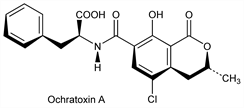
Chemical structure

Derivative

Ochratoxin A.

Nomenclature

CAS number: 303-47-9
(R)-N-[(5-Chloro-3,4-dihydro-8-hydroxy-3-methyl-1-oxo-1H-2-benzopyran-7-yl)carbonyl]-l-phenylalanine.
C20H18ClNO6; mol wt 403.81.
C 59.49%, H 4.49%, Cl 8.78%, N 3.47%, O 23.77%.

Properties

The major ochratoxin component. Crystals from xylene, mp 169°. Exhibits green fluorescence. [α]D -118° (c = 1.1 in CHCl3). uv max (ethanol): 215, 333 nm (ε 34000; 2400) (van der Merwe). Also frequently reported as mp 90° from benzene (one mole of benzene of crystallization). uv max: 213, 332 nm (ε 36800; 6400) (Steyn, Holzapfel). LD50 orally in rats: 20-22 mg/kg (Purchase, Theron).

Derivative

Ochratoxin B.

Nomenclature

CAS number: 4825-86-9
(R)-N-[(3,4-Dihydro-8-hydroxy-3-methyl-1-oxo-1H-2-benzopyran-7-yl)carbonyl]-l-phenylalanine.
C20H19NO6; mol wt 369.37.
C 65.03%, H 5.18%, N 3.79%, O 25.99%.

Properties

The less toxic dechloro deriv of ochratoxin A. Crystals from methanol, mp 221° (van der Merwe); also reported as 208-209° (Nesheim). Exhibits blue fluorescence. [α]D -35° (c = 0.15 in ethanol). uv max: 218, 318 nm (ε 37200, 6900).

Derivative

Ochratoxin C.

Nomenclature

CAS number: 4865-85-4
(R)-N-[(5-Chloro-3,4-dihydro-8-hydroxy-3-methyl-1-oxo-1H-2-benzopyran-7-yl)carbonyl]-l-phenylalanine ethyl ester.
C22H22ClNO6; mol wt 431.87.
C 61.18%, H 5.13%, Cl 8.21%, N 3.24%, O 22.23%.

Properties

The equally toxic amorphous ethyl ester of ochratoxin A: Steyn, Holzapfel, J. S. Afr. Chem. Inst. 20, 186 (1967), C.A. 69, 2797p (1968). uv max (ethanol): 333 nm (ε 6500).

Caution

Ochratoxin A is reasonably anticipated to be a human carcinogen: Report on Carcinogens, Eleventh Edition (PB2005-104914, 2004) p III-209.

Use

Exptlly as teratogen and carcinogen.