7031. Paraquat

Nomenclature

CAS number: 4685-14-7
1,1′-Dimethyl-4,4′-bipyridinium; N,N′-dimethyl-γ,γ′-dipyridylium; methyl viologen (2+).
[C12H14N2]2+.

Description and references

Non-selective contact herbicide. Prepn of dichloride and bismethyl sulfate derivs: L. Michaelis, E. S. Hill, J. Am. Chem. Soc. 55, 1481 (1933); R. C. Brian et al., GB 813531 (1959 to ICI). Activity: R. F. Homer et al., J. Sci. Food Agric. 11, 309 (1960); A. D. Dodge, Endeavour 30, 130 (1971). Degradation: A. Calderbank, P. Slade, Outlook Agric. 5, 55 (1966); A. Calderbank, T. E. Tomlinson, ibid. 252 (1968); A. Calderbank, ibid. 6, 128 (1970). Toxicity studies: D. G. Clark et al., Br. J. Ind. Med. 23, 126 (1966); D. M. Conning et al., Br. Med. Bull. 25, 245 (1969); R. D. Kimbrough, T. B. Gaines, Toxicol. Appl. Pharmacol. 17, 679 (1970); J. F. Dasta, Am. J. Hosp. Pharm. 35, 1368 (1978). Controversial use on marijuana plants: R. J. Smith, Science 199, 861 (1978). Review: A. A. Akhavein, D. L. Linscott, Residue Rev. 23, 97-145 (1968); A. Calderbank, P. Slade in Herbicides: Chemistry, Degradation and Mode of Action, P. C. Kearney, D. Kaufman, Eds. (Dekker, New York, 2nd ed., 1976) pp 501-540.
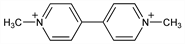
Chemical structure

Derivative

Dichloride.

Nomenclature

CAS number: 1910-42-5
PP-148; Gramoxone (Syngenta).
C12H14Cl2N2; mol wt 257.16.
C 56.05%, H 5.49%, Cl 27.57%, N 10.89%.

Properties

Colorless crystals, mp 300° (dec). Very sol in water, slightly sol in lower alcohols. Insol in hydrocarbons. Hydrolyzed by alkali. Inactivated by inert clays and anionic surfactants. Corrosive to metal. Non-volatile. Normal potential at 30°: -0.446 volts. LD50 orally in rats: 125 mg/kg (Conning).

Derivative

Bismethyl sulfate.

Nomenclature

CAS number: 2074-50-2
Paraquat I; PP-910.
C14H20N2O8S2; mol wt 408.45.
C 41.17%, H 4.94%, N 6.86%, O 31.34%, S 15.70%.

Properties

Yellow solid. LD50 orally in male rats: 100 mg/kg (Kimbrough, Gaines).

Caution

Potential symptoms of overexposure to paraquat dichloride are irritation of eyes, skin, nose, throat, respiratory system; epistaxis; dermatitis; fingernail damage; irritation of GI tract; heart, liver, kidney damage. See NIOSH Pocket Guide to Chemical Hazards (DHHS/NIOSH 97-140, 1997) p 240.

Use

Herbicide. Dichloride as biological oxidation-reduction indicator.