7030. Paraoxon

Nomenclature

CAS number: 311-45-5
Phosphoric acid diethyl 4-nitrophenyl ester; diethyl p-nitrophenyl phosphate; phosphacol; E-600; Ester 25; Eticol; Fosfakol; Mintacol; Miotisal A; Soluglaucit.
C10H14NO6P; mol wt 275.20.
C 43.64%, H 5.13%, N 5.09%, O 34.88%, P 11.26%.

Description and references

Prepd by the action of diethyl chlorophosphate on sodium p-nitrophenolate or by nitration of diethyl phenyl phosphate: Schrader, BIOS Final Report No. 714, 52 (1947); Angew. Chem. 62, 471 (1950); CH 257649 (1949); Fagerlind et al., Sven. Farm. Tidskr. 56, 303, C.A. 46, 9259. Physical properties: E. F. Williams, Ind. Eng. Chem. 43, 950 (1951). Formation from parathion on citrus foliage and soil surface: R. C. Spear et al., J. Agric. Food Chem. 23, 808 (1975); W. F. Spencer et al., Bull. Environ. Contam. Toxicol. 14, 265 (1975). Toxicity study: W. R. Pickering, J. C. Malone, Biochem. Pharmacol. 16, 1183 (1967). Brief review: G. Schrader, Die Entwicklung neuer insektizider Phosphors"aure-Ester (Verlag Chemie, Weinheim, 1963) pp 259-272.
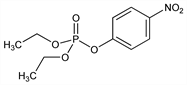
Chemical structure

Properties

Oily liq. Slight odor. Poisonous. bp1.0 169-170°. d425 1.2683. nD20 1.50959. uv max: 274 nm (ε 8.9×10³). Soly in water (25°): 2400 μg/mL. Freely sol in ether, other organic solvents. Aq solns are stable up to pH 7. Roughly 300 times more stable to hydrolysis than tetraethyl pyrophosphate. The uncatalyzed reaction with water is very small and the overall velocity constant is K = 0.52[OH] + 1×10⁻⁶ min-1. See: Coates, Ann. Appl. Biol. 36, 158 (1949). LD50 orally in rats: 1.8 mg/kg (Pickering, Malone).

Caution

Cholinesterase inhibitor. For symptoms see Parathion.

Use

Insecticide.