Nomenclature
CAS number: 56-38-2
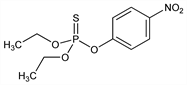
Phosphorothioic acid
O,O-diethyl
O-(4-nitrophenyl)
ester;
O,O-diethyl
O-p-nitrophenyl phosphorothioate; diethyl-
p-nitrophenyl monothiophosphate; DNTP; S.N.P.; E-605; AC-3422; ENT-15108; Alkron (Kerr-McGee); Folidol (Bayer); Fostox E (Siapa); Rhodiatox (Rhone-Poulenc); Thiophos.
C
10H
14NO
5PS; mol wt 291.26.
C 41.24%, H 4.84%, N 4.81%, O 27.47%, P 10.63%, S 11.01%.
Description and references
Non-systemic contact and stomach insecticide
and acaricide; cholinesterase inhibitor. Prepn: Thurston, FIAT Report 949 (1946); Coates,
Topley, BIOS Final Report 1808 (1947). See also Fletcher et al., J. Am. Chem. Soc. 70, 3943 (1948).
Conversion to toxic oxygen analogs: See Paraoxon. Toxicity study: T. B. Gaines, Toxicol. Appl. Pharmacol. 14, 515
(1969). Review: Hall in Adv.
Chem. Ser. 1, entitled “Agricultural Control
Chemicals” (ACS, Washington DC, 1950) p 150. Review of industrial
syntheses: Chadwick, Watt, “Thiophosphates” in Phosphorus and Its Compounds vol. 2, J. R.
Van Wazer, Ed. (Interscience, New York, 1961) pp 1257-1262. Review
of distribution, transport and fate in the environment: M. S. Mulla et al., Residue Rev. 81, 1-159 (1981); of carcinogenic risk: IARC Monographs 30, 153-181 (1983).
Properties
Pale yellow liquid. bp760 375°; bp0.6 157-162°. mp 6°. nD25 1.5370. d425 1.26. Vapor pressure at 20°: 3.78×10⁻⁵ mm Hg. Surface
tension at 25°: 39.2 dynes/cm. Viscosity (25°): 15.30 cP. Absorption
spectra: Williams, Ind. Eng. Chem. 43, 950 (1951). Freely sol in alcohols, esters, ethers,
ketones, aromatic hydrocarbons. Practically insol in water (20 ppm),
petr ether, kerosene, and the usual spray oils. Incompatible with
substances having a pH higher than 7.5. LD50 in female, male rats (mg/kg): 3.6, 13 orally; 6.8, 21 dermally (Gaines).Caution
Potential symptoms of overexposure
are miosis; rhinorrhea; headache; tight chest, wheezing, laryngeal
spasm, salivation and cyanosis; anorexia, nausea, vomiting, abdominal
cramps and diarrhea; sweating; muscle fasciculation, weakness and
paralysis; giddiness, confusion and ataxia; convulsions, coma; low
blood pressure; cardiac irregularities; skin, eye and respiratory
system irritation. See NIOSH Pocket
Guide to Chemical Hazards (DHHS/NIOSH 97-140, 1997) p
240; Clinical Toxicology of Commercial Products, R. E. Gosselin et al., Eds. (Williams & Wilkins,
Baltimore, 5th ed., 1984) Section III, pp 336-343.Use
Insecticide; acaricide.