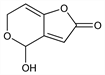
7053. Patulin
Nomenclature
Description and references
An antibiotic derived from the metabolites of a number of fungi, e.g., Aspergillus clavatus, A. claviforme, A. giganteus, A. terreus, Penicillium patulum, P. expansum, P. melinii, P. leucopus, P. urticae and Gymnoascus spp. Isoln and antibacterial activity: Birkinshaw et al., Lancet 245, 625 (1943); Birkinshaw, Michael, US 2417584 (1947 to Therap. Res. Corp. of Great Britain); cf. Waksman et al., Science 96, 202 (1942); Brack, Helv. Chim. Acta 30, 1 (1947); Norstadt, McCalla, Appl. Microbiol. 17, 193 (1969). Structure: Birkinshaw, loc. cit.; Bergel et al., J. Chem. Soc. 1944, 415; Woodward, Singh, J. Am. Chem. Soc. 71, 758 (1949); Shemyakin, Khokhlov, Dokl. Akad. Nauk SSSR 75, 47 (1950). Synthesis: Woodward, Singh, J. Am. Chem. Soc. 72, 1428 (1950). Biosynthesis: Bu'Lock, Ryan, Proc. Chem. Soc. London 1958, 222; Tanenbaum, Bassett, J. Biol. Chem. 234, 1861 (1959). Inhibition of K+ ion uptake in erythrocytes: Kahn, J. Pharmacol. Exp. Ther. 121, 234 (1957). Physicochemical data: A. E. Pohland et al., Pure Appl. Chem. 54, 2219 (1982). Has carcinogenic activity attributable to α,β-unsaturation together with an external conjugated double bond attached to 4 position of the γ-lactone ring: Dickens, Br. Med. Bull. 20, 96 (1964). Toxicity: R. Kinosita, T. Shikata, “On Toxic Moldy Rice” in Mycotoxins in Foodstuffs, G. N. Wogan, Ed. (The M.I.T. Press, Cambridge, 1965) pp 117-119. Review and evaluation of studies of carcinogenic action in laboratory animals: IARC Monographs 10, 205-210 (1976). Review: Ciegler et al., “Patulin, Penicillic Acid and Other Carcinogenic Lactones” in Microbial Toxins vol. VI, A. Ciegler et al., Eds. (Academic Press, New York, 1971) p 409-414.