Nomenclature
CAS number: 109-66-0
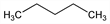
n-Pentane.
C
5H
12; mol wt 72.15.
C 83.23%, H 16.76%.
Description and references
Occurs in petroleum; it is a constituent of
petr ether. Sepn from natural gasoline: Love, Pet. Eng. 12, no. 10, 130 sqq (1941), C.A. 35, 7162 (1941); from virgin
naphthas: Tongberg et al., Ind. Eng. Chem. 30, 166 (1938). Prepd by dehydration and subsequent hydrogenation
of 2- and 3-pentanol: Mair, Bur. Stand. J. Res. 9, 457 (1932); from 2-bromopentane by Grignard reaction: Noller, Org. Synth. 11, 84 (1931). Toxicity data: Fühner, Biochem. Z. 115, 235 (1921).
Properties
Liquid. d40 0.64529; d420 0.62638; d430 0.6163.
mp -129.7°. bp760 36.1°; bp400 18.5°; bp200 1.9°; bp100 -12.6°; bp60 -22.2°; bp40 -29.2°; bp20 -40.2°; bp10 -50.1°; bp5 -62.5°; bp1.0 -76.6°. nD20 1.35768. Flash pt, closed cup: <-40°F (-40°C). Flammable. Explosive limits,
% by vol in air: lower 1.4; upper 8.0. Autoignition temp +588°F
(+309°C). Soly in water at 16°: 0.36 g/l. Miscible with alc, ether,
many organic solvents. LC (in air) in mice: 377 mg/l (Fühner).Caution
Potential symptoms of overexposure
are drowsiness; irritation of eyes, skin, nose. Direct contact may
cause dermatitis; aspiration of liquid may cause chemical pneumonia.
See NIOSH Pocket Guide to Chemical
Hazards (DHHS/NIOSH 97-140, 1997) p 244.