7204. Phenacetin
Nomenclature
CAS number: 62-44-2
N-(4-Ethoxyphenyl)acetamide; p-acetophenetidide; p-ethoxyacetanilide; acetophenetidin; para-acetphenetidin; acet-p-phenetidin; p-acetophenetide. C10H13NO2; mol wt 179.22.
C 67.02%, H 7.31%, N 7.82%, O 17.85%.
Description and references
Prepn: Beilstein vol. XIII, 461. Improved process: Eaker, Campbell, US 2887513 (1959 to Monsanto). Monograph: P. K. Smith, Acetophenetidin (Interscience, New York, 1958) 180 pp. Toxicity: Boyd, Toxicol. Appl. Pharmacol. 1, 240 (1959). Review of toxicity and metabolism studies: L. Fishbein, IARC Sci. Publ. 40, 287-310 (1981). Epidemiologic study of renal morbidity and mortality: U. C. Dubach et al., N. Engl. J. Med. 308, 357 (1983). Evaluation of renal effects: D. P. Sandler et al., ibid. 320, 1238 (1989).
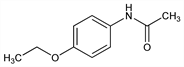
Properties
Slightly bitter, cryst scales or powder. mp 134-135°. One gram dissolves in 1310 ml cold water, 82 ml boiling water; 15 ml cold alcohol, 2.8 ml boiling alcohol; 14 ml chloroform, 90 ml ether; sol in glycerol. Gives a pasty mass with phenol, chloral hydrate or pyrocatechol, strong acids or alkalies, salicylic acid, oxidizers, iodine, spirit nitrous ether. LD50 orally in rats: 1.65 g/kg (Boyd).Note
Component of APC tablets, analgesic mixture also containing aspirin and caffeine.Caution
Phenacetin is reasonably anticipated to be a human carcinogen; analgesic mixtures containing phenacetin are listed as known human carcinogens: Report on Carcinogens, Eleventh Edition (PB2005-104914, 2004) p III-212.Therapeutic Category
Analgesic, antipyretic.
Therapeutic Category (Veterinary)
Analgesic, antipyretic.Keywords
Analgesic; Non-opioids; Anilides; Antipyretic