7271. Phenylalanine
Nomenclature
Description and references
Essential amino acid for human development. Originally isolated from the sprouts of lupine: E. Schulze, J. Barbieri, Ber. 12, 1924 (1879). Early chemistry and biochemistry: Amino Acids and Proteins, D. M. Greenberg, Ed. (Charles C. Thomas, Springfield, IL, 1951) 950 pp. passim; J. P. Greenstein, M. Winitz, Chemistry of the Amino Acids vols 1-3 (John Wiley and Sons, Inc., New York, 1961) pp. 2156-2177, passim. Synthesis from l-tyrosine: V. Viswanatha, V. J. Hruby, J. Org. Chem. 45, 2010 (1980). Colorimetric determn in blood: R. S. Campbell et al., Ann. Clin. Biochem. 31, 140 (1994). Effects on food intake: G. H. Anderson, L. A. Leiter, Appetite 11, Suppl. 48 (1988); P. J. Rogers, J. E. Blundell, Physiol. Behav. 56, 247 (1994). Clinical trial in vitiligo: C. Antoniou et al., Int. J. Dermatol. 28, 545 (1989); A. H. Siddiqui et al., Dermatology 188, 215 (1994). Review of metabolism: H. N. Munro, J. Toxicol. Environ. Health 2, 189-206 (1976). Review of role in phenylketonuria: S. P. Bessman, Nutr. Rev. 37, 209-220 (1979); F. Güttler, Acta Paediatr. Scand. 73, 705-716 (1984). Review of microbial production: T. K. Maiti, S. P. Chatterjee, Hind. Antibiot. Bull. 32, 3-26 (1990).
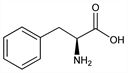
Properties
Monoclinic plates, leaflets from warm concd aq solns. Hydrated needles from dil solns. Dec 283°. Sublimes in vacuo. [α]D20 -35.1° (c = 1.94). pK1 1.83; pK2 9.13. Soly in water (g/l): 19.8 at 0°; 29.6 at 25°; 44.3 at 50°; 66.2 at 75°; 99.0 at 100°. Very slightly sol in methanol, ethanol.Derivative
d-Form.Nomenclature
Description and references
Occurs naturally in microbial products such as tyrocidine, q.v.: A. H. Gordon et al., Biochem. J. 37, 313 (1943). May be used as a source for l-form in man. Biotransformation: S. Tokuhisa et al., Chem. Pharm. Bull. 29, 514 (1981). Evaluation of d-form in multiple sclerosis: A. Winter, Neurol. Orthopaed. J. Med. Surg. 5, 39 (1984).