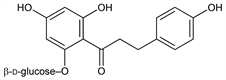
7327. Phloridzin
Nomenclature
Description and references
A dihydrochalcone occurring in all parts of the apple tree except the mature fruit. Once thought to occur in pear, plum, cherry trees and other Rosaceae: A. H. Williams in Comparative Phytochemistry, T. Swain, Ed. (Academic Press, New York, 1966) pp 297-307. Isoln from root bark: De Koninck, Ann. 15, 75, 258 (1835); Stass, Ann. 30, 192 (1839); Bridel, Kramer, Bull. Soc. Chim. Biol. 15, 544 (1933). Hydrolysis by dil mineral acids yields phloretin and glucose. Procedure for acid hydrolysis: Wessely, Sturm, Monatsh. Chem. 53-54, 557 (1929); Müller, Robertson, J. Chem. Soc. 1933, 1170. The energy of activation required for the hydrolysis is much less than for other glucosides and approaches that for γ-fructosides (sucrose, raffinose). Is hydrolyzed by saccharase at pH 4.45, by enzymes of Aspergillus niger and other enzymes found in invertebrates: Kobert, Pfluegers Arch. Gesamte Physiol. Menschen Tiere 99, 116 (1903); Moelwyn-Hughes, J. Gen. Physiol. 13, 807 (1930); cf. Trans. Faraday Soc. 25, 81 (1929). Synthesis: Zemplen, Bognár, Ber. 75B, 1040 (1942); cf. ibid. 645 and 76B, 386 (1943).