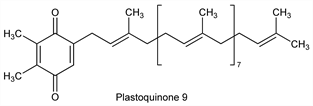
7523. Plastoquinones
Nomenclature
PQs.Description and references
Family of lipid-soluble benzoquinone derivatives involved in photosynthetic electron transport. Structurally and functionally analogous to the ubiquinones, q.v. Structures are characterized by a side chain of repeating isoprenoid units with 9 units being the most common. Originally discovered by Kofler in 1946. Isoln of PQ-9 from alfalfa: F. L. Crane, Plant Physiol. 34, 546 (1959). Localization in chloroplasts and role in photosynthesis: N. I. Bishop, Proc. Natl. Acad. Sci. USA 45, 1696 (1959). Structure: M. Kofler et al., Helv. Chim. Acta 42, 2252 (1959); N. R. Trenner et al., J. Am. Chem. Soc. 81, 2026 (1959). Synthesis: C. H. Shunk et al., ibid. 5000. Identification of plastoquinone analogs B and C: L. P. Kegel et al., Biochem. Biophys. Res. Commun. 8, 294 (1962). Review of role in photosynthetic electron flow: U. Siggel, Bioelectrochem. Bioenerg. 3, 302-318 (1976); A. Trebst in Coenzyme Q, G. Lenaz, Ed. (John Wiley & Sons, Chichester, 1985) pp 257-284.