7559. Polifeprosan
Nomenclature
Description and references
Biodegradable, hydrophobic polymers developed for use as implantable drug delivery systems. Prepn of various copolymers: K. W. Leong et al., Polym. Prepr. 25, 201 (1984); eidem, J. Biomed. Mater. Res. 19, 941 (1985). Toxicology and biocompatibility studies: C. T. Laurencin et al., Clin. Lab. Med. 10, 549 (1990). Review of polymer design, synthesis and physical properties: J. Tamada, R. Langer, J. Biomater. Sci. Polym. Ed. 3, 315-353 (1992).
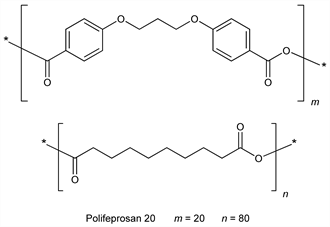
Derivative
Polifeprosan 20.Description and references
High mol wt polymer consisting of bis(p-carboxyphenoxy)propane and sebacic acid in a 20:80 ratio. Mol wt 20,000-200,000. Prepn: A. J. Domb, R. S. Langer, EP 266603; eidem, US 4757128 (both 1988 to MIT); eidem, J. Polym. Sci. 25, 3373 (1987).
Properties
White solid, mp 68°. Viscosity (in chloroform at 23°): 0.92 dl/g. Soly (g/100ml): >20 in chloroform; <1 in hexane.Derivative
Gliadel (Aventis).Description and references
Polifeprosan 20 combined with carmustine, q.v., in an implantable wafer. Prepn and characterization of polymer-drug matrix: W. Dang et al., Pharm. Res. 13, 683 (1996); A. J. Domb et al., ibid. 16, 762 (1999). Clinical trial of surgically implanted wafer for malignant gliomas: H. Brem et al., Lancet 345, 1008 (1995); S. Valtonen et al., Neurosurgery 41, 44 (1997).