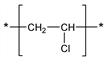
7586. Polyvinyl Chloride
Nomenclature
Description and references
Polyvinyl chloride fibers are marketed under the names: Rhovyl, Fibravyl, Thermovyl, Isovyl, Retractyl, Crinovyl, Envilon, Nip. Average mol wt ≈60,000 to 150,000. Prepn: Baumann, Ann. 163, 308 (1872); Schoenfeld, US 2168808 (1937 to B. F. Goodrich). Structure: Natta, Rigamonti, Atti Accad. Naz. Lincei Cl. Sci. Fis. Mat. Nat. Rend. 24, 381 (1936); C.A. 31, 45639 (1937); Marvel et al., J. Am. Chem. Soc. 61, 3241 (1939). Reviews: C. E. Schildknecht, Vinyl and Related Polymers (Wiley, New York, 1952) pp 392-442. Technology: W. S. Penn, PVC Technology (Maclaren, London, 1962); J. A. Davidson, K. L. Gardner, “Vinyl Polymers (PVC)” in Kirk-Othmer Encyclopedia of Chemical Technology vol. 23 (Wiley-Interscience, New York, 3rd ed., 1983) pp 886-936. Book: Sarvetnick, Polyvinyl Chloride (Van Nostrand, Reinhold, New York, 1969).