Nomenclature
CAS number: 9002-89-5
Ethenol homopolymer; PVA; Akwa Tears (Akorn); Elvanol (DuPont); Gelvatol (Monsanto); Liquifilm (Allergan); Mowiol (Hoechst); Polyviol (Wacker); Sno Tears (Chauvin); Vinarol (Gen. Dyes); Vinol (Air Prods. Chem.).
Description and references
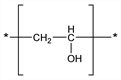
A polymer prepd from polyvinyl acetates by
replacement of the acetate groups with hydroxyl groups. The alcoholysis
proceeds most rapidly in a methanol + methyl acetate mixture in the
presence of catalytic amounts of alkali or mineral acids: Hermann,
Haehnel, Ber. 60, 1658
(1927). Monograph: C. E. Schildknecht, Vinyl and Related Polymers (Wiley, New York,
1952). The head-to-tail or 1,3-glycol structure is favored: Staudinger et al., Ber. 60, 1782 (1927); J. Prakt. Chem. 155, 261 (1940); Marvel, Denoon, J. Am. Chem. Soc. 60, 1045 (1938); McDowell,
Kenyon, ibid. 62, 415
(1940); Marvel, Inskeep, ibid. 65, 1710 (1943). Reviews: M. Leeds in Kirk-Othmer Encyclopedia of Chemical Technology vol. 21 (Wiley-Interscience, New York, 2nd ed., 1970)
pp 353-368; Polyvinyl Alcohol,
A. C. Finch, Ed. (Wiley, New York, 1973) 640 pp; A. S. Dunn, Chem. Ind. (London) 1980, 801-806.
Vinyl alcohol monomer has not been isolated. Review:
R. B. Seymour, G. B. Kauffman, J. Chem. Educ. 71, 582 (1994). Comprehensive description: D. Wong,
J. Parasrampuria, Anal. Profiles Drug Subs.
Excip. 24, 397-441 (1996).
Properties
Dry, unplasticized polyvinyl alcohol powders are
white to cream colored, soften at about 200° with decompn. Commercial
polyvinyl alcohols have different contents of residual acetyl groups
and therefore different viscosity characteristics. The first code
number following the trade name indicates the degree of hydrolysis,
while the second set of numbers indicates the approx viscosity in
cP (4% aq soln at 20°). Polyvinyl alcohols are essentially sol in
hot and cold water, but those coded 20-105 require alcohol-water mixtures.
Aq solns are colloidal and compatible with lower alcohols. Pure
aq solns are neutral or faintly acid and subject to mold growth.
Insol in petroleum solvents.Use
In the plastics industry in molding compds, surface
coatings, films resistant to gasoline, textile sizes and finishing
compositions; can be compounded to yield elastomers to be used in
manuf artificial sponges, fuel hoses, etc., also in printing inks
for plastics and glass, in pharmaceutical finishing, cosmetics, water-sol
film and sheeting. Pharmaceutic aid (viscosity increasing agent);
ophthalmic lubricant.