7795. Propagermanium
Nomenclature
Description and references
Biologic response modifier. Polymeric organogermanium compound. Orginally synthesized at Asai Germanium Institute in 1967. Prepn and crystal structure: M. Tsutsui et al., J. Am. Chem. Soc. 98, 8287 (1976). Toxicology and clinical pharmacokinetics: K. Miyao et al., Curr. Chemother. Infect. Dis. 2, 1527 (1979). TLC quantitation: X. Peishan et al., J. Planar Chromatogr. Mod. TLC 3, 141 (1990). Electrochemical behavior and determn: K. Hasebe et al., Electroanalysis 6, 779 (1994). Antiviral activity: Y. Ishiwata et al., Arzneim.-Forsch. 44, 357 (1994). Review of biological activities and mechanism of antitumor action: R. R. Brutkiewicz, F. Suzuki, In Vivo 1, 189-204 (1987). Review: K. Miyao, N. Tanaka, Drugs Future 13, 441-453 (1988). Review of clinical use as an immunostimulant: H. Fukazawa et al., Head Neck 16, 30-38 (1994).
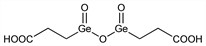
Properties
Colorless, monoclinic crystals or crystalline powder having no odor but a slightly acidic taste. mp 270° (dec). pKa 3.6. Sol in water at 1.09% at 20°. Insol or very slightly sol in almost all organic solvents. Very sol in water under alkaline conditions; >10% at pH 7.4. Aq solns exhibit acid reactions. Stable at pH 2-12, especially at pH 7.4 especially where decomposition does not occur at 110° for 5 min. LD50 i.p. in mice: 2.8 g/kg (Brutkiewicz).Therapeutic Category
Antineoplastic; immunostimulant.
Keywords
Antineoplastic; Immunomodulators; Immunomodulator