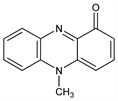
7951. Pyocyanine
Nomenclature
CAS number: 85-66-5
5-Methyl-1(5H)-phenazinone. C13H10N2O; mol wt 210.23.
C 74.27%, H 4.79%, N 13.33%, O 7.61%.
Description and references
Blue redox pigment produced by Pseudomonas aeruginosa. Important virulence factor in pseudomonal infection. Isoln: Wrede, Strack, Z. Physiol. Chem. 140, 1 (1924); Schoental, Br. J. Exp. Pathol. 22, 137 (1941). Synthesis: Wrede, Strack, Z. Physiol. Chem. 181, 58 (1929); Ber. 62, 2051 (1929); Surrey, Org. Synth. 26, 86 (1946); coll. vol. III, 753 (1955). HPLC determn in sputum: R. Wilson et al., Infect. Immun. 56, 2515 (1988). Review of biosynthesis and role in pathogenesis: G. W. Lau et al., Trends Mol. Med. 10, 599-606 (2004).