8172. Rhamnose

Nomenclature

CAS number: 3615-41-6
6-Deoxy-l-mannose; l-rhamnose; l-mannomethylose; isodulcit.
C6H12O5; mol wt 164.16.
C 43.90%, H 7.37%, O 48.73%.

Description and references

Occurs free in poison sumac (Rhus toxicodendron L., Anacardiaceae), combined in the form of glycosides of many plants. Preparation: Clark, J. Biol. Chem. 38, 255 (1919). Structure and configuration: Fischer, Morrell, Ber. 27, 384 (1894); Fischer, Zach, ibid. 45, 3762 (1912); Hirst, Macbeth, J. Chem. Soc. 1926, 23; Avery, Hirst, ibid. 1929, 2466. Isoln from walls of gram-negative bacteria: Salton, Biochim. Biophys. Acta 45, 364 (1960); from Afraegle paniculata Engl., Rutaceae: Torto, J. Chem. Soc. 1961, 5234; from rabbit skin: Malawista, Davidson, Nature 192, 871 (1961); from leaves of Solanum chacoense Bitter, Solanaceae: Kuhn, L"ow, Ber. 94, 1088 (1961).
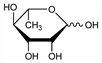
Chemical structure

Derivative

α-Form.

Properties

Always obtained by crystn from H2O or EtOH. Monohydrate, holohedric rods from water, hemihedric monoclinic columns from alcohol. Loses water of crystn on heating and partially changes to the β-modification. Very sweet taste. mp 82-92°: Ghosh, Proc. R. Soc. Edinburgh 36, 216 (1915/16). Sublimes at 105° and 2 mm Hg. d420 1.4708. Shows mutarotation. [α]D20 -7.7° → +8.9°: Hudson, Yanovsky, J. Am. Chem. Soc. 39, 1032 (1917).

Derivative

β-Form.

Properties

Prepd by heating α-rhamnose monohydrate on a steam bath; crystallized from anhydr acetone + alcohol. Needles, mp 122-126° (rapid heating). [α]D20 +31.5° (1 min, p = 10). After a short time the rotation adjusts to the same final value as α-rhamnose. The β-form is hygroscopic and changes into crystals of the α-modification upon exposure to moist air.