8484. Sialic Acids
Nomenclature
Nonulosaminic acids.Description and references
Family of amino sugars contg 9 or more carbon atoms, N- and O-substituted derivatives of neuraminic acid, q.v. Widely distributed throughout the animal kingdom; appear to be regular components of all types of mucoproteins, mucopolysaccharides and certain mucolipids. Bovine and ovine submaxillary gland sialic acids are diacetyl derivs. Pig submaxillary mucin, and pig, horse, and ox erythrocytes contain sialic acids having an N-glycolyl group. Reviews: A. Gottschalk, The Chemistry and Biology of Sialic Acids and Related Substances (Cambridge U. Press, 1960); idem, Rev. Pure Appl. Chem. 12, 46 (1962). Books: Biological Roles of Sialic Acid, A. Rosenberg, C.-L. Schengrund, Eds. (Plenum Press, New York, 1976) 393 pp; Sialic Acids: Chemistry, Metabolism & Function, R. Schauer, Ed. (Springer-Verlag, New York, 1983) 346 pp.
Derivative
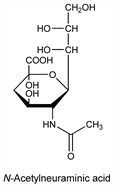
N-Acetylneuraminic acid.Nomenclature
5-(Acetylamino)-3,5-dideoxy-d-glycero-d-galacto-2-nonulosonic acid; NAN; NANA; lactaminic acid; O-sialic acid.Description and references
The most important of the 5 sialic acids. Isoln: Klenk, Faillard, Z. Physiol. Chem. 298, 230 (1954). Prepn from sheep submaxillary mucins: Blix, Methods Carbohydr. Chem. 1, 246 (1962). Synthesis: Cornforth et al., Biochem. J. 68, 57 (1958); R. Csuk et al., Helv. Chim. Acta 71, 609 (1988). First synthesis from non-carbohydrate sources: M. P. DeNinno, S. J. Danishevsky, J. Org. Chem. 51 2615 (1986). Configuration: Kuhn, Brossmer, Angew. Chem. Int. Ed. 1, 218 (1962).