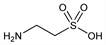
9074. Taurine
Nomenclature
Description and references
Conditionally essential sulfonated amino acid synthesized in the liver from cysteine and methionine. Important during mammalian development, especially for cells of the cerebellum and retina. Physiological roles include: bile acid conjugation, osmoregulation, membrane stabilization, calcium homeostasis, and regulation of retinal and cardiac function. Isoln from ox bile: Hammarsten, Z. Physiol. Chem. 32, 456 (1901); from abalone (Haliotis): C. L. A. Schmidt, T. Watson, J. Biol. Chem. 33, 499 (1918). Prepn by treatment of salts of 2-chloroethane-1-sulfonic acid with NH3: J. W. James, J. Prakt. Chem. Chem.-Ztg. 31, 413 (1885); starting with 2-bromoethanesulfonate: C. S. Marvel, C. F. Bailey, Org. Synth. coll. vol. II, 563 (1943); by Na2SO3 sulfonation of ethylene chloride followed by ammonolysis with anhydr NH3 or aq NH3 and ammonium carbonate: J. W. Schick, F. Degering, Ind. Eng. Chem. 39, 906 (1947); from aziridines: L. Hu et al., J. Org. Chem. 72, 4543 (2007). Crystal density study: D. E. Hibbs et al., Chem. Eur. J. 9, 1075 (2003). Review of separation and determn methods: S. Mou et al., J. Chromatogr. B 781, 251-267 (2002). Importance to retinal function in cats: K. C. Hayes et al., Invest. Ophthalmol. 15, 52 (1976). Review of role in nutrition: H. P. Redmond et al., Nutrition 14, 599-604 (1998); of role in retinal function: L. Lima, Neurochem. Res. 24, 1333-1338 (1999); of therapeutic potential in diabetes: S. H. Hansen, Diabetes Metab. Res. Rev. 17, 330-346 (2001); of immunomodulatory effects: G. B. Schuller-Levis, E. Park, FEMS Microbiol. Lett. 226, 195-202 (2003).