9371. Thiram
Nomenclature
CAS number: 137-26-8
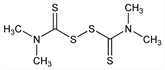
Tetramethylthioperoxydicarbonic diamide; bis(dimethylthiocarbamoyl) disulfide; bis(dimethylthiocarbamyl) disulfide; tetramethylthiuram disulfide; TMTD; ENT-987; SQ-1489; NSC-1771; Thiurad (Flexsys); Thylate (DuPont); Fernasan (Zeneca); Nomersan (Zeneca); Rezifilm (BMS); Pomarsol (Bayer); Tersan (DuPont); Tuads (Vanderbilt); Arasan (DuPont). C6H12N2S4; mol wt 240.43.
C 29.97%, H 5.03%, N 11.65%, S 53.35%.
Description and references
Prepn: v. Braun, Stechele, Ber. 35, 820 (1902); 36, 2280 (1903); Romani, C.A. 16, 854 (1922); Cummings, Simmons, Ind. Eng. Chem. 20, 1173 (1928). Acute toxicity: Gaines, Toxicol. Appl. Pharmacol. 14, 515 (1969). Review of carcinogenic risk: IARC Monographs 12, 225 (1976).
Properties
Crystals from chloroform + alcohol, mp 155-156° (commercial grades, mp 146°). d 1.29. Insol in water, dil caustic, gasoline. Soly in alcohol and in ether less than 0.2%; soly in acetone 1.2%; in benzene 2.5%. Sol in chloroform, acetone. LD50 orally in rats: 640 mg/kg (Gaines).Caution
Potential symptoms of overexposure are irritation of eyes, skin, mucous membranes; dermatitis; Antabuse-like effects. See NIOSH Pocket Guide to Chemical Hazards (DHHS/NIOSH 97-140, 1997) p 306. A potent skin sensitizer. Toxicity greater in presence of fats, oils, fat solvents. See Clinical Toxicology of Commercial Products, R. E. Gosselin et al., Eds. (Williams & Wilkins, Baltimore, 5th ed., 1984) section III, pp 383-386.Use
Rubber accelerator; vulcanizer; seed disinfectant; fungicide; bacteriostat in soap; animal repellent.Therapeutic Category
Antiseptic.