Nomenclature
CAS number: 21259-20-1
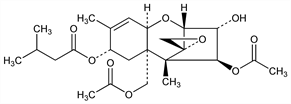
(3α,4β,8α)-12,13-Epoxytrichothec-9-ene-3,4,8,15-tetrol 4,15-diacetate
8-(3-methylbutanoate); 3α-hydroxy-4β,15-diacetoxy-8α-(3-methylbutyryloxy)-12,13-epoxy-Δ
9-tricothecene; 8α-(3-methylbutyryloxy)-4β,15-diacetoxyscirp-9-en-3α-ol; fusariotoxin T-2; insariotoxin; mycotoxin T-2; NSC-138780.
C
24H
34O
9; mol wt 466.52.
C 61.79%, H 7.35%, O 30.87%.
Description and references
Tricothecene mycotoxin isolated from Fusarium tricinctum: J. R. Bamburg et al., Tetrahedron 24, 3329 (1968). Physicochemical data: A. E. Pohland et al., Pure Appl. Chem. 54, 2119 (1982). Synthesis: M. C. Wani et al., J. Org. Chem. 52, 3468 (1987). Biosynthetic study: F. Van Middlesworth et al., J. Org. Chem. 55, 1237 (1990). Toxicology studies: W. F. O. Marasas et al., Toxicol. Appl. Pharmacol. 15, 471 (1969); H. B. Schiefer, D. S. Hancock, ibid. 76, 464 (1984); D. A. Creasia et al., Fundam. Appl. Toxicol. 14, 54 (1990). Implicated as a chemical warfare agent
in Southeast Asia with nivalenol, q.v.: N. Wade, Science 214, 34 (1981); R. T. Rosen, J. D. Rosen, Biomed. Mass Spectrom. 9, 443
(1982). Review: Developments
in Food Science vol. 4, Y. Ueno, Ed., entitled “Trichothecenes:
Chemical, Biological and Toxicological Aspects” (Kodansha Ltd. and
Elsevier, New York, 1983) 310 pp. Review of pharmacokinetics and
metabolism: B. Yagen, M. Bialer, Drug Metab.
Rev. 25, 281-323 (1993).
Properties
Crystals, mp 151-152°. [α]D26 +15° (c = 2.58 in ethanol).
Freely sol in ethyl alcohol, ethyl acetate, chloroform, DMSO and other
organic solvents; slightly sol in petroleum ether; very slightly sol
in water. LD50 orally in female rats: 4.0 mg/kg (Marasas). LD50 (mg/kg) in mice: 5.2 i.p., 4.2 i.v.; in rats: 7.0 intragastric, 0.9-1.3 i.p., 0.9 i.v., 2.0 s.c.; in guinea pigs: 3.0-4.0 orally, 5.3 intragastric, 1.0 i.m., 1.0-2.0 i.v., 1.0-2.0 s.c.; in pigs: 5.0 orally, 3.0 i.v. (Yagen, Bailer).Caution
May be highly irritating to skin
and mucous membranes. Direct contact may cause extensive inflammation
and tissue necrosis (Marasas). Topical exposure has lead to systemic
toxicity and death in experimental animals (Schiefer, Hancock).