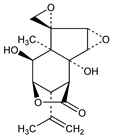
9827. Tutin
Nomenclature
Description and references
Poisonous constituent of Coriaria ruscifolia L. or C. japonica A. Gray, (tutu) Coriariaceae. Naturally occurring form is (+)-tutin. Isoln: Easterfield, Aston, J. Chem. Soc. 79, 125 (1901). Structure: Johns, Markham, ibid. 1961, 3006; Craven, Nature 197, 1193 (1963); Mackay, Mathieson, Tetrahedron Lett. 1963, 1399. Absolute configuration: Okuda, Yoshida, ibid. 1965, 2137. Biosynthesis: A. Corbella et al., Chem. Commun. 1969, 634. NMR analysis: J. W. Blunt et al., Aust. J. Chem. 32, 1339 (1979). Stereospecific synthesis: K. Watamatsu et al., Tetrahedron 42, 5551 (1986). Determn in toxic honey: J. L. Love et al., N.Z. J. Technol. 2, 179 (1986). Effect on central nervous system: D. R. Curtis et al., Brain Res. 63, 419 (1973); A. Nistri et al., Lancet 1, 996 (1974). Toxicity data: C. H. Jarboe et al., J. Med. Chem. 11, 729 (1968).