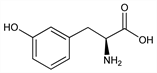
9840. m-Tyrosine
Nomenclature
Description and references
A possible precursor of catecholamines: Sourkes et al., Nature 189, 577 (1961). An intermediate in an alternate pathway for the biosynthesis of catecholamines, where with the existing hydroxylating enzymes m-hydroxylation of phenylalanine to m-tyrosine occurs before p-hydroxylation (forming dopa) and is followed by subsequent decarboxylation to dopamine. Formation in vitro of dopa from l-m-tyrosine: Tong et al., Biochem. Biophys. Res. Commun. 43, 819 (1971); in vivo: Hollunger, Persson, Acta Pharmacol. Toxicol. 34, 391 (1974). Biosynthesis and metabolism studies: D'Iorio et al., Adv. Neurol. 5, 265 (1974). Has also been isolated from a plant source, Euphorbia myrsinites L. Euphorbiaceae: Mothes et al., Z. Naturforsch. 19b, 1161 (1964). m-Tyrosine has the ability to cross the blood-brain barrier and is decarboxylated to m-tyramine which stimulates dopamine receptors, presumably accounting for the demonstrated pharmacological effects of m-tyrosine. Pharmacological studies: Carlsson, Lindqvist, Eur. J. Pharmacol. 2, 187 (1967); Rubenson, J. Pharm. Pharmacol. 23, 228, 412 (1971); Sandler et al., Nature 229, 414 (1971); Ungerstedt et al., Eur. J. Pharmacol. 21, 230 (1973). Crystal and molecular structure: Byrkjedal et al., Acta Chem. Scand. 28B, 750 (1974).