9874. Urethan

Nomenclature

CAS number: 51-79-6
Carbamic acid ethyl ester; ethyl aminoformate; ethyl carbamate; urethane; ethyl urethan.
C3H7NO2; mol wt 89.09.
C 40.44%, H 7.92%, N 15.72%, O 35.92%.

Description and references

Naturally occurring contaminant in fermented foods, particularly wine, stone-fruit brandies, and bread. Prepd by heating urea with alcohol under pressure; by warming urea nitrate with alcohol and sodium nitrite. Toxicity data: K. J. Franklin, J. Pharmacol. Exp. Ther. 42, 1 (1931). Review of carcinogenic action and metabolism: S. S. Mirvish in Adv. Cancer Res. 11, 1-42 (1968); of mutagenicity, metabolism and interactions with DNA: R. E. Sotomayor, T. F. X. Collins, Toxicol. Ind. Health 6, 71-108 (1990); of physiological effects in animals: K. J. Field, C. M. Lang, Lab. Anim. 22, 255-262 (1988). Review of analysis, occurrence and formation in foodstuffs: R. Battaglia et al., Food Addit. Contam. 7, 477-496 (1990); B. Zimmerli, J. Schlatter, Mutat. Res. 259, 325-350 (1991).
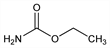
Chemical structure

Properties

Crystals, mp 48-50°. Cooling saline taste, d 1.1. bp 182-184°. Sublimes readily at 103° and 54 mm pressure. One gram dissolves in 0.5 ml water, 0.8 ml alcohol, 0.9 ml chloroform, 1.5 ml ether, 2.5 ml glycerol, 32 ml olive oil. The aq soln is neutral. MLD i.p. in mice: 2.1-2.2 g/kg (Franklin).

Caution

This substance is reasonably anticipated to be a human carcinogen: Report on Carcinogens, Eleventh Edition (PB2005-104914, 2004) p III-270.

Use

Intermediate in organic synthesis. In the prepn and modification of amino resins. As solvent, solubilizer and cosolvent for various organic materials. Animal anesthetic in laboratory procedures.