9938. Vasopressin
Nomenclature
Description and references
The water-soluble pressor principle prepd by synthesis or obtained from the posterior lobe of the pituitary of healthy domestic animals used for food by man: USP XVIII, 770. Separation from oxytocin: Kamm et al., J. Am. Chem. Soc. 50, 573 (1928). Purification: Turner et al., J. Biol. Chem. 191, 21 (1951). Two vasopressins, differing only in the amino acid at position 8, have been isolated: arginine vasopressin, from human, beef, chicken, horse and sheep pituitaries, and lysine vasopressin (lypressin, q.v.), from porcine pituitaries. Review: E. Schrder, K. Lübke, The Peptides vol. II (Academic Press, New York, 1966) pp 336-350; C. R. W. Edwards, “Vasopressin” in Hormones in Blood vol. 2, C. H. Gray, V. H. T. James, Eds. (Academic Press, London, 3rd ed., 1979) pp 423-450. Book: Antidiuretic Hormone vol. 4, M. L. Forsling, Ed. (Eden Press, Quebec, 1980) 165 pp.
Derivative
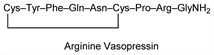
Arginine vasopressin.Nomenclature
Argipressin; rinder-vasopressin.Description and references
Structure: du Vigneaud et al., J. Am. Chem. Soc. 75, 4880 (1953). Synthesis: du Vigneaud et al., ibid. 80, 3355 (1958); Bodanszky et al., ibid. 86, 4452 (1964); Meienhofer et al., ibid. 92, 7199 (1970); Jones et al., J. Org. Chem. 38, 2865 (1973). Fever suppressing activity: K. E. Cooper et al., J. Physiol. (London) 295, 33 (1979). Effect on female sexual behavior in rats: P. Sdersten et al., Nature 301, 608 (1983).
Derivative
Ornithine vasopressin see Ornipressin.Therapeutic Category
Antidiuretic and vasopressor hormone; hemostatic.
Therapeutic Category (Veterinary)
Antidiuretic hormone; in deficiency conditions.Keywords
Antidiuretic; Hemostatic