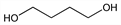
10312. 1,4-Butanediol
Nomenclature
Description and references
Commercial chemical used in the manufacture of polymer fibers and plastics. Metabolically converted to the CNS depressant, γ-hydroxybutyrate, (GHB) q.v. Prepn from N,N′-dinitrobutanediyldiamine: M. P. J. Dekkers, Recl. Trav. Chim. Pays-Bas 9, 92 (1890); from 4-benzyloxybutan-1-ol: W. R. Kirner, G. H. Richter, J. Am. Chem. Soc. 51, 2503 (1929) DOI. LC-MS/MS determn in urine: M. Wood et al., J. Chromatogr. A 1056, 83 (2004) DOI PubMed. Toxicological profile: R. D. Irwin, J. Appl. Toxicol. 26, 72 (2006) DOI PubMed. Clinical pharmacokinetics, metabolism, and toxicology: D. Thai et al., Clin. Pharm. Ther. 81, 178 (2007) DOI PubMed. Review of abuse as substitute for GHB: R. B. Palmer, Toxicol. Rev. 23, 21-31 (2004) DOI PubMed. Review of industrial prepns and uses: M. L. Morgan, Chem. Ind. (London) 3, 166-168 (1997); T. Haas et al., Appl. Catal. A 280, 83-88 (2005) DOI.