10326. Histatins
Nomenclature
Histidine-rich proteins; parotid basic proteins; post-parotid basic proteins.Description and references
Group of small, cationic, salivary proteins with antimicrobial and wound healing properties. Histatins bind to hydroxyapatite and have a role in the acquired enamel pellicle of human teeth. Produced and secreted by the parotid and submandibular salivary glands; histatins 1, 3, and 5 are the most abundant. Histatins 1 and 3 are the primary gene products; other histatins are proteolytic fragments of the 2 parent proteins. Isoln of histidine-rich proteins from human parotid saliva: D. I. Hay, Arch. Oral Biol. 20, 553 (1975) DOI PubMed; B. J. Baum et al., Arch. Biochem. Biophys. 177, 427 (1976) DOI PubMed. Characterization and structures of histatins 1, 3, 5: F. G. Oppenheim et al., J. Biol. Chem. 263, 7472 (1988) PubMed; of 2, 4, and 6 -12: R. F. Troxler et al., J. Dent. Res. 69, 2 (1990) PubMed. Identification of HIS genes: L. M. Sabatini, E. A. Azen, Biochem. Biophys. Res. Commun. 160, 495 (1989) DOI PubMed. Improved isoln via zinc precipitation: B. Flora et al., Protein Expression Purif. 23, 198 (2001) DOI PubMed. Review of structures, activity, and therapeutic potential as antifungal agents: H. Tsai, L. A. Bobek, Crit. Rev. Oral Biol. Med. 9, 480-497 (1998) PubMed; K. Kavanagh, S. Dowd, J. Pharm. Pharmacol. 56, 285-289 (2004) DOI PubMed. Wound-closure stimulating properties: M. J. Oudhoff et al., FASEB J. 22, 3805 (2008) DOI PubMed.
Derivative
Histatin 1.Nomenclature
Description and references
Primary translation product of the HIS1 gene; contains 38 amino acid residues, including a phosphorylated serine at position 2.
Properties
pI 7.04.Derivative
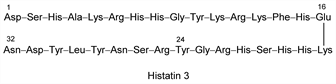
Histatin 3.Nomenclature
Description and references
Primary translation product of the HIS2 gene; contains 32 amino acid residues.
Properties
pI >9.5.Derivative
Histatin 5.Nomenclature
Description and references
Proteolytic cleavage product of histatin 3 corresponding to residues 1-24.