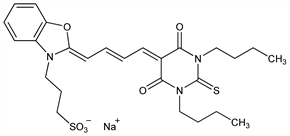
10342. Merocyanine 540
Nomenclature
Description and references
Prototype fluorescent dye used to study plasma membrane potential; originally developed for use in photography. Adopts an all-trans arrangement in the ground state and isomerizes upon photoexcitation. Preferentially binds to viable electrically excitable cells, leukemic cells, and apoptotic cells. Exhibits phototoxicity towards neoplastic cells and viruses. Preparative method and membrane potential studies in living cells: L. B. Cohen et al., J. Membr. Biol. 19, 1 (1974) DOI PubMed. Staining of electrically excitable cells: T. G. Easton et al., Cell 13, 475 (1978) DOI PubMed; of leukemic cells: J. E. Valinsky et al., ibid. 487 DOI PubMed. Photochemical and photophysical properties: J. Davila et al., Photochem. Photobiol. 53, 1 (1991) DOI PubMed; A. C. Benniston et al., J. Phys. Chem. A 107, 4347 (2003) DOI. Spectroscopy studies: B. Cunderlíková, L. Sikurová, Chem. Phys. 263, 415 (2001) DOI. Biodistribution and toxicity of photoproducts: S. Pervaiz et al., Cancer Chemother. Pharmacol. 31, 467 (1993) DOI PubMed. Review of biomedical applications: F. Sieber, Photochem. Photobiol. 46, 1035-1042 (1987) DOI PubMed. Use in flow cytometry to detect apoptosis: T. Laakko et al., J. Immunol. Methods 261, 129 (2002) DOI PubMed. Clinical evaluation for purging of autologous stem cell grafts: G. S. Anderson et al., J. Photochem. Photobiol. B 69, 87 (2003) DOI PubMed.