|
|
|
|
|
|
|
return. However, the portfolio as a whole should consist of promising product candidates that meet these requirements in the aggregate. Furthermore, adjustments should be made to reestablish the appropriate portfolio balance when projects either drop out or finish development. |
|
|
|
|
|
|
|
|
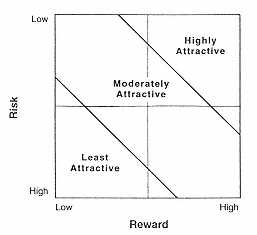
A frequent failing of those who conduct a portfolio analysis is to rank the projects in a priority list, with the high-reward/low-risk projects at the top and the high-risk/low-reward projects at the bottom. The risk-reward grid is a graphic representation of the relative attractiveness of each project: high-reward, low-risk projects are most attractive, and low-reward, high-risk projects are least attractive. This is illustrated in Figure 8. But attractiveness should not be the only criterion for establishing a priority list. |
|
|
|
|
|
|
|
|
Projects should be prioritized by comparing their relative attractiveness with their strategic value to the company [1]. An example of this quantitative analysis is shown in Figure 9. It is important to set strategic objectives that target specific markets, defined by therapeutic area and in some cases by specific market segment. In setting the long term direction of the pipeline, emphasis should not be on where the company is, but where it is going. The strategic goals must state clearly the position of the company 510 years from now, not restate the current situation. Some examples of endpoints that should be considered in assessing strategic value are listed in Table 7. |
|
|
|
|
|
|
|
|
Fig. 8
Project attractiveness. The risk/reward grid
is annotated to identify the most attractive
(upper right), moderately attractive
(diagonal center), and least attractive
(lower left) projects in the portfolio. |
|
|
|
|
|