|
|
|
|
|
|
|
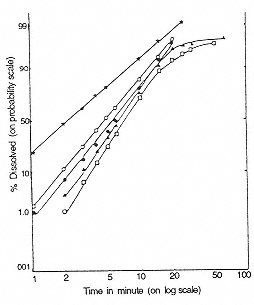
Fig. 9
Wagner plot on dissolution tests of tablets
compressed at 20°C containing 010 × 10-5 M/g
of light liquid paraffin: lactose 0 M/g (filled
star), 0.5 × 10⁻⁵ M/g (filled circle), 1 × 10⁻⁵
M/g (open circle), 5 × 10⁻⁵ M/g (filled
triangle), and 10 × 10-5 M/g (open square)
[Int. J. Pharm. 15: 73, 1983]. |
|
|
|
|
|
|
|
|
in the rates at which the active ingredient(s) are liberated from the given dosage form. |
|
|
|
|
|
|
|
|
Literature is replete with information about the characteristics of the active ingredient that can influence the dissolution and thereby the bioavailability performance of the drug and the drug product. Additionally, the use of excipients, virtually in all cases, in the fabrication of drug dosage form interferes with the dissolution performance of the drug and the drug product. Such intervention can be advantageous when the dissolution performance is enhanced for a poorly soluble drug, or the dissolution rate is controlled over a prolonged period for a drug appropriate for modified drug delivery. In several instances, however, the dissolution process, both rate and extent, is changed without notice (unpredictable). This is particularly true in case of fast-acting or rapid-release dosage forms. Figures 5-14 illustrate the effects of some of the critical variables that profoundly influence the dissolution performance of the drug |
|
|
|
|
|