|
|
|
|
|
|
|
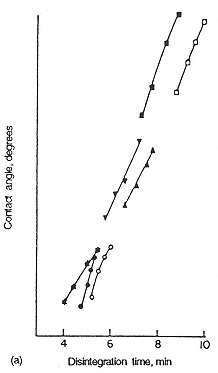
Fig. 10
(a) Correlation of contact angle of water
on the powder compacts containing
0.5-10 × 10-5 M/g of paraffins and
silicones with the disintegration time
(min.) of the corresponding tablets
compressed at 20°C: light liquid
paraffin (filled circle), liquid paraffin
(open circle), white soft paraffin (filled
triangle), paraffin (open square),
silicone dc 200/20 (filled star), silicone
dc 200/50 (filled inverted triangle), and
silicone dc 550 (filled square). (b)
Correlation of contact angle of water
on the powder compacts containing
0.5-10 × 10-5 M/g of paraffins with t90
and t100 of the corresponding tablets
compressed at 20°C: light liquid
paraffin -t90 (filled circle), t100 (open
circle); liquid paraffin -t90 (filled
inverted triangle), t100 (open inverted
triangle); white soft paraffin t90 (filled
triangle), t100 (open triangle); paraffin
wax -t90 (filled square), t100 (open
square) [Int. J. Pharm. 15: 75, 1983]. |
|
|
|
|
|
|
|
|
and the drug product and that are germane to the characteristics of drug and excipients incorporated in the formulation. |
|
|
|
|
|
|
|
|
2. Modeling Dissolution Behavior |
|
|
|
|
|
|
|
|
The absorption of the active ingredient is regulated by physiochemical properties of the drug and the manner in which it is formulated. The primary prop- |
|
|
|
|
|