|
|
|
|
|
|
|
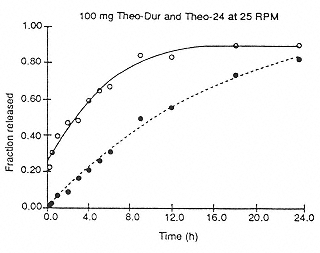
Fig. 19
Dissolution profile of Theo-Dur (open circles) and Theo-24
(closed circles). |
|
|
|
|
|
|
|
|
A typical profile series is shown in Fig. 20. Three such profiles were generated, one for each strength. |
|
|
|
|
|
|
|
|
When the release profiles for the three different strengths of Theo-24 are subjected to nonlinear regression analysis, and the initial zero-order release rate constant, B, is plotted versus the effect of agitation [Log (RPM)], the effect of agitation on release rate becomes apparent as shown in Fig. 21. |
|
|
|
|
|
|
|
|
Formulation Development. If a release profile is changed by the addition of an excipient, either by changing the amount or some measurable, quantifiable characteristic such as molecular weight, hydrophile-lipophile balance (HLB), polymeric index, etc., in a homologous series, it is likely that the change in release profile is reflected in a change in one or more of the parameters in the |
|
|
|
|
| Table 6 Comparison of Parameters Obtained Using the Makoid-Banakar Function to Fit the Dissolution of Two Dosage Forms of Sustained Released Theophylline | | FRI | | | | | | | Theo-24 | 0 | | | | | | | Theo-Dur | 0.247 | | | | | | | B and C are as previously described in the Makoid-Banakar function and FRI is the calculated fraction released immediately from the parameter A as described in the text. |
|
|
|