|
|
|
|
|
|
|
the variables to yield the sought after parameters, B and C. Or, conversely, a family of curves might be created for various polymer types and used as a ready reference for the formulation of sustained release products. |
|
|
|
|
|
|
|
|
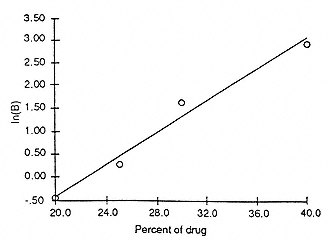
A second example comes from the same meeting where Lootens et al. (1991) presented a paper in which they evaluated the release of homidium bromide from a slow-release device. Parameters B and C determined from the release profiles provided versus percent of homidium bromide in the device (Figs. 25 and 26) show quantitatively the effect of the drug amount on the release profiles. |
|
|
|
|
|
|
|
|
Clearly, these simple equations (Makoid-Banakar function and Modified Makoid-Banakar function) meet the requirements of the scientific process, even without a complex theory to give them credibility. These are practical equations that allow one to impose order on the chaos which surrounds us. They are useful only to the extent that they reduce the myriad of observations to manageable, understandable, and predictable parameters/variable sets. They are easy to utilize and thus have practical utility. |
|
|
|
|
|
|
|
|
The relationships between the parameters themselves or the excipients need not be linear or log linear. They can be virtually any function (one hopes continuous or, at worst, reproducibly discontinuous). Asymptotic or parabolic functions between parameters and excipients might tell the concentration (or other independent variable) above which no change (or a deleterious change) is predicted to occur, which is exactly that happened when we consulted with a major drug company on the formulation of one of their sustained release products. The relationships between the parameters B and C themselves are linked |
|
|
|
|
|
|
|
|
Fig. 25
Effect of drug load on parameter B. |
|
|
|
|
|