|
|
|
|
|
|
|
to the excipient. Thus, as discussed in the Gilbert paper, the B, C relationship is fixed to the pluronic grade, as they would be with any independent variable. Consequently, not all combinations of B and C are available, as discussed, which in itself may save investigation time. All of the forgoing calculations resulted from a review of literature data, not data created to show relationships. |
|
|
|
|
|
|
|
|
Let us now turn to the determination of the values of A, B, and C for a hypothetical optimal delivery system. Beauty is in the eyes of the beholder. Consequently, what comprises an optimum can be reasonably and logically argued. However, given that the decision to create a delivery system with a particular release profile has been made, what are the parameters necessary to create such a delivery system? |
|
|
|
 |
|
|
|
|
First question: How long should the product last (release drug)? You (or marketing, more likely) decide that the delivery system should release the drug for 10 h. If Tpeak is 10 h, then 1/C is 10 h. Thus C = 0.1 h-1. |
|
|
|
|
|
|
|
|
Second question: Do you want a time lag or burst effect? |
|
|
|
|
|
|
|
|
When A is zero, release begins at time zero. |
|
|
|
|
|
|
|
|
When A is positive, you get a time lag. |
|
|
|
|
|
|
|
|
When A is negative, you get a burst effect. |
|
|
|
|
|
|
|
|
Third question: How much of the drug do you want to be released by Tpeak? Assuming that you want it all gone by Tpeak (FM = 1), B can be calculated from FM in the Makoid-Banakar function: FM = B/C×EXP(-1). Thus for our theoretical delivery system, B = C/EXP(-1) = 0.1/0.368 = 0.272. |
|
|
|
|
|
|
|
|
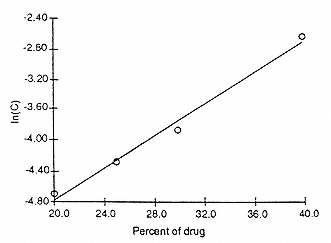
Fig. 26
Effect of drug load on parameter C. |
|
|
|
|
|