|
|
|
|
|
|
|
Sometimes dissolution and absorption profiles are better characterized by rate constants of their respective kinetic profiles. However, pharmacokinetic models have to be established, proven, and fitted to confirmed determinations in each single case. |
|
|
|
|
|
|
|
|
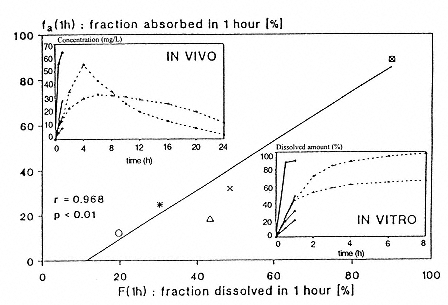
Correlation parameters have to be selected according to their kinetic importance rather than empirically formed relation between any in vivo or in vitro data set. Quality, efficacy, and safety of a modified release preparation, for example, cannot possibly be anticipated by controlling the fraction absorbed in 1 h (Chung and Changkoo, 1987) (Fig. 28). The significance of such a correlation is very limited. |
|
|
|
|
|
|
|
|
Another possibility is the occurrence of accidental linear correlation when nonanalogous data are compared, e.g., area under the curve (AUC) as a function of fraction of dose absorbed at a given time F(t), which do not represent any causal or functional relation. Such correlations are susceptible to malfunction and are extremely sensitive to slight variations in the testing procedure. |
|
|
|
|
|
|
|
|
Misinterpretations can be avoided by correlating analogous in vivo and in vitro parameters. Analogous parameters (Banakar and Makoid, 1992b) are defined as analyzed data in vitro versus their respective calculated or predicted in vitro data and vice versa (Fig. 29). Some examples of analogous pairs are, |
|
|
|
|
|
|
|
|
Fig. 28
In vitro-in vivo correlations for theophylline preparations [data from J.
Pharm. Sci. 76: 784, 1987]. |
|
|
|
|
|