|
|
|
|
|
|
|
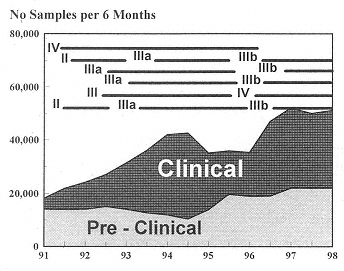
Fig. 3
The graph shows the increases in the annual workload for the
laboratory, apportioned to the preclinical and clinical support.
The bars indicate the duration of various clinical trials with the
roman numerals indicating the phase of development. Late-stage
development compounds, supported by the laboratory, are each
represented by one of the horizontal tracks. |
|
|
|
|
|
|
|
|
20 European countries. For the 120 single-center clinical trials completed during 1992-95, 64 were supported by the laboratory. A further 32 pan-European multicenter trials were also supported during the same period. |
|
|
|
|
|
|
|
|
During 1994/95 samples were received from 6,770 patients from 809 separate centers. Because of the way centers and patients are recruited into a clinical trial and the way investigators organise their patient visits, the clinical pathology laboratory has only the broadest idea of how many samples can be expected on a given day. As illustrated in Figure 4, which shows the daily workload between July 1994 and June 1995, the participation of a large number of investigators produces a reasonably even workload of about 150 ± 30 samples each day. The laboratory still has to cope with the cyclical nature of toxicology samples but, at least, the laboratory has samples to analyse every day. |
|
|
|
|
|
|
|
|
A. Laboratory Changes Required to Accommodate the Additional Workload |
|
|
|
|
|
|
|
|
One major proviso for undertaking the support of clinical trials was that no significant increase in manpower would be allowed. For sample analysis, this |
|
|
|
|
|