|
|
|
|
|
|
|
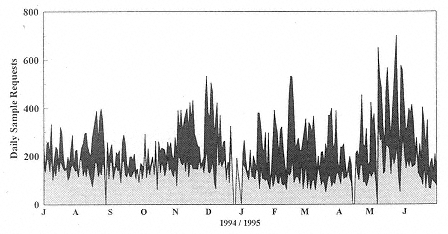
Fig. 4
Daily workload for the period July 1994 to June 1995 is displayed. The clinical
workload is represented by the light stippled area while the darker area represents the
pre-clinical toxicology workload for the laboratory. |
|
|
|
|
|
|
|
|
was achieved by integrating the three disciplines under one management and adopting a policy of training all the staff to work in all areas under the guidance of specialized leaders. This approach provided maximum flexibility for resourcing the laboratory and each member of staff works 3 months before rotating into another discipline or to another activity within the same discipline. The majority of staff enjoyed the variety that the rotation offered and, in any one year, an individual may be a trainee in one area and acting as a trainer in another. |
|
|
|
|
|
|
|
|
In order to fully meet the needs of our clinical program it was necessary for us to develop an expertise in endocrinology and the assay of surrogate markers. A nonisotopic, automated immunoassay analyzer was the only capital purchase made to support clinical trials. As instruments were replaced, however, analyzers of higher capacity and faster throughput were purchased at minimal extra cost. The purchase of state-of-the-art high-specification equipment also benefitted toxicology since analytical turnaround times were reduced by 75% and new assays, developed for clinical trials, could be modified for use with animals. |
|
|
|
|
|
|
|
|
It soon became clear, in order to effectively support clinical trials, that the laboratory had to provide much more than just an analytical service. The administration of blood sample packs and transport, patient result management and the administration of patient demography details were all key activities that had to be supported. The first was achieved by developing an effective |
|
|
|
|
|