|
|
|
|
|
|
|
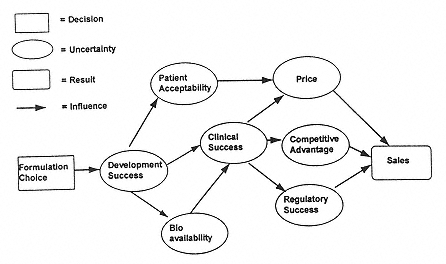
FIG. 4
An example of an influence diagram. |
|
|
|
|
|
|
|
|
separate probabilities. For example, the probability of throwing two fours with a pair of dice is 1/6 × 1/6 = 1/36. If there are a number of events which are mutually exclusive, the probability that any one of them happens is additive. For example, the probability of throwing either a three or a five with a single die is 1/6 + 1/6 = 1/3. This is important because R&D success depends on all uncertainties being successful. Fig. 5 illustrates the use of a decision tree to show how a decision to invest one of two possible levels of funding into a project affects eventual project value. |
|
|
|
|
|
|
|
|
In this example, there is a choice of investing either $90M or $50M in a project. Investing $90M reduces overall project risk, but the question is, Does the reduction in risk translate into an overall increase in project value? By constructing a decision tree and mapping the likely outcomes, it is clear that, in this example, the return on the project from investing $90M is significantly higher than the return on the project from investing $50M. Decision trees are the basis of many modeling tools for portfolio analysis. |
|
|
|
|
|
|
|
|
C.
Monte Carlo Simulation |
|
|
|
|
|
|
|
|
This is a relatively complex technique for risk assessment though there are a number of commercially available software packages to alleviate the |
|
|
|
|
|