423. p-Aminobenzoic Acid
Nomenclature
Description and references
Widely distributed in nature as a B complex factor. Baker's yeast contains 5 to 6 ppm, brewer's yeast from 10 to 100 ppm. Occurs free and in ester form. Prepn: Toland, Heaton, US 2878281 (1959 to Calif. Research Corp.); Spiegler, US 2947781 (1960 to Du Pont); Nielson et al., J. Chem. Soc. 1962, 371. Purification: Lyding, US 2735865 (1956 to Heyden Chem.). Antirickettsial activity: M. L. Robbins et al., J. Immunol. 64, 431 (1950). Toxicity studies: C. C. Scott, E. B. Robbins, Proc. Soc. Exp. Biol. Med. 49, 184 (1942); R. K. Richards, Fed. Proc. 1, 71 (1942); G. Cronheim, ibid. 10, 289 (1952). Comprehensive description: H. A. El-Obeid, A. A. Al-Badr, Anal. Profiles Drug Subs. Excip. 22, 33-106 (1993).
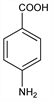
Properties
Monoclinic prisms from dil alcohol. May turn slightly yellow on prolonged exposure to light and air. mp 187.0-187.5°. pKa: 4.65, 4.80; pH (0.5% soln): 3.5. uv max (water): 266 nm (E1%1cm 1070); (isopropanol): 288 nm (E1%1cm 137). One gram dissolves in 170 ml water at 25°, in 90 ml boiling water; in 8 ml alcohol, in 50 ml ether. Sol in ethyl acetate, glacial acetic acid; slightly sol in benzene. Practically insol in petr ether. Incompatible with ferric salts and oxidizing agents. LD50 in mice, rats (g/kg): 2.85, >6.0 orally (Scott, Robbins). LD50 in rabbits (g/kg): 2.0 i.v. (Richards); 1.83 orally (Cronheim).Derivative
Diethylamine salt.Nomenclature
Properties
Crystals from acetone mp 170-173°. Very soluble in water.Derivative
Potassium salt see Potassium p-Aminobenzoate.Note
p-Aminobenzoic acid is also known as anti-gray-hair factor (in rats only).Use
Manuf various esters (local anesthetics), folic acid, and azo dyes; in sunburn preventives. Used in laboratories as sulfonamide antagonist.Therapeutic Category
Ultraviolet screen. Formerly as antirickettsial.
Therapeutic Category (Veterinary)
Has been used in eczema nasi (“collie nose”) in dogs.Keywords
Antirickettsial; Ultraviolet Screen