584. Amphomycin
Nomenclature
Description and references
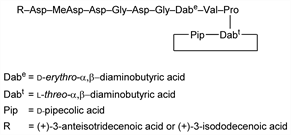
Polypeptide antibiotic modified at the amino terminus with a fatty acid moiety; active against gram positive bacteria. Produced by Streptomyces canus from soil collected near Syracuse, N.Y.: B. Heinemann et al., Antibiot. Chemother. 3, 1239 (1953). Production: eidem, US 3126317 (1964 to Bristol-Myers). Structure and identity with glumamycin: M. Bodanszky et al., J. Am. Chem. Soc. 95, 2352 (1973). Pharmacology and toxicity: D. E. Tisch et al., Antibiot. Annu. 1954-1955, 1011. Mechanism of action: H. Tanaka et al., Biochem. Biophys. Res. Commun. 86, 902 (1979). Use to improve feed efficiency in ruminant animals: M. Gordon, G. J. Christie, DE 3027370; eidem, US 4414206 (1981, 1983 both to Bristol-Myers).
Properties
Acidic, surface-active polypeptide. [α]D25 +7.5° (c = 1 at pH 6). Isoelectric point 3.5-3.6. Soluble in water and the lower alcohols. Insol in nonpolar solvents. Aq solns at neutral pH are stable at room temp for at least one month. Forms sodium and calcium salts. Induces hemolysis. Suggested as a topical agent for animal and plant infections.Derivative
Sodium salt.Properties
Amorphous solid, sol in water. LD50 in mice (mg/kg): 177.8 i.v. (Tisch).Derivative
Calcium salt.Properties
Crystalline solid, sol in water, methyl alcohol. Used in combination with other antibiotics as antibacterial ingredient in topical anti-inflammatory preparations. LD50 in mice (mg/kg): 120.2 i.v. (Tisch).Therapeutic Category
Antibacterial.
Keywords
Antibacterial (Antibiotics); Polypeptides