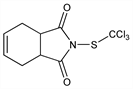
1772. Captan
Nomenclature
CAS number: 133-06-2
3a,4,7,7a-Tetrahydro-2-[(trichloromethyl)thio]-1H-isoindole-1,3(2H)-dione; N-(trichloromethylthio)-4-cyclohexene-1,2-dicarboximide; N-trichloromethylthio-3a,4,7,7a-tetrahydrophthalimide; N-trichloromethylmercapto-4-cyclohexene-1,2-dicarboximide; N-(trichloromethylmercapto)-Δ4-tetrahydrophthalimide; ENT-26538; SR-406; Merpan; Orthocide-406; Vancide 89. C9H8Cl3NO2S; mol wt 300.59.
C 35.96%, H 2.68%, Cl 35.38%, N 4.66%, O 10.65%, S 10.67%.
Description and references
Prepn: A. R. Kittleson, US 2553771; US 2653155; US 2713058 (1951, 1953, 1955 all to Standard Oil); idem, Science 115, 84 (1952); idem, J. Agric. Food Chem. 1, 677 (1953). Colorimetric determination: A. R. Kittleson, Anal. Chem. 24, 1173 (1952). Review of mutagenicity studies: B. A. Bridges, Mutat. Res. 32, 3 (1975); of carcinogenic risk: IARC Monographs 30, 295-318 (1983).