2832. Daunorubicin
Nomenclature
Description and references
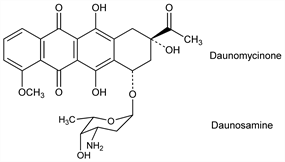
Anthracycline antibiotic related to the rhodomycins, q.v. Isolated from fermentation broths of Streptomyces peucetius: G. Cassinelli, P. Orezzi, G. Microbiol. 11, 167 (1963), C.A. 62, 9482b (1965); A. Di Marco et al., Nature 201, 706 (1964); eidem, BE 639897; eidem, US 4012284 (1964, 1977 both to Soc. Farmaceut. Italia); S. Pinnert et al., US 3997662 (1976 to Rhone-Poulenc). Daunorubicin is a glycoside formed by a tetracyclic aglycone, daunomycinone, (C21H18O8) and an amino sugar, daunosamine, (C6H13NO3), 3-amino-2,3,6-trideoxy-l-lyxo-hexose: F. Arcamone et al., J. Am. Chem. Soc. 86, 5334, 5335 (1964); R. H. Iwamoto et al., Tetrahedron Lett. 1968, 3891. Absolute stereochemistry: F. Arcamone et al., Gazz. Chim. Ital. 100, 949-989 (1970). Identity with rubidomycin: G. L. Tong et al., J. Pharm. Sci. 56, 1691 (1967). Synthesis of daunosamine: J. P. Marsh et al., Chem. Commun. 1967, 973; T. Yamaguchi, M. Kojimo, Carbohydr. Res. 59, 343 (1977); P. M. Wovkulich, M. R. Uskokovic, J. Am. Chem. Soc. 103, 3956 (1981); of daunomycinone: C. M. Wong et al., Can. J. Chem. 51, 466 (1973); J. S. Swenton, P. W. Reynolds, J. Am. Chem. Soc. 100, 6188 (1978); K. Krohn, K. Tolkiehn, Ber. 112, 3453 (1979); F. M. Hauser, S. Prasanna, J. Am. Chem. Soc. 103, 6378 (1981). Total synthesis of daunorubicin: E. M. Acton et al., J. Med. Chem. 17, 659 (1974). Purification: E. Oppici et al., BE 898506; eidem, GB 2133005 (both 1984 to Farmitalia). Toxicity data: A. Di Marco et al., Cancer Chemother. Rep. Part 1 53, 33 (1969). Review of properties, biosynthesis, fermentation: R. J. White, R. M. Stroshane, Drugs Pharm. Sci. 22, 569-594 (1984); of carcinogenic action in laboratory animals: IARC Monographs 10, 145-152 (1976); of toxicology: R. J. Maral et al., Cancer Treat. Rep. 65, Suppl. 4, 9-18 (1981); of use in treatment of solid tumors: R. B. Weiss et al., ibid. 25-28; of interactions with nucleic acids: S. Neidle, M. R. Sanderson, in Molecular Aspects of Anti-cancer Drug Action, S. Neidle, M. J. Waring, Eds. (Verlag-Chemie, Florida, 1983) pp 35-55; of mechanism of cytotoxicity: H. S. Schwartz, ibid. pp 93-125; of metabolism and clinical pharmacokinetics: C. E. Riggs, Jr., Semin. Oncol. 11, Suppl. 3, 2-11 (1984). Review: A. DiMarco et al., Antibiotics vol. 3, J. W. Corcoran, F. E. Hahn, Eds. (Springer Verlag, New York, 1975) pp 101-128.
Properties
mp 208-209°. LD50 in mice, rats (mg/kg): 20, 13 i.v.; 5, 8 i.p. (DiMarco, 1977).Derivative
Hydrochloride.Nomenclature
Properties
Thin red needles, dec 188-190°. [α]D20 +248 ±5° (c = 0.05-0.1 in methanol). Sol in water, methanol, aq alcohols. Practically insol in chloroform, ether, benzene. Color of aq soln changes from pink at acid pH to blue at alkaline pH. Absorption max (methanol): 234, 252, 290, 480, 495, and 532 nm (E1%1cm 665, 462, 153, 214, 218, and 112). LD50 in mice (mg/kg): 26 i.v. (DiMarco, 1969).Therapeutic Category
Antineoplastic.
Keywords
Antineoplastic; Antibiotics and Analogs; Anthracyclines; Topoisomerase II Inhibitor