Nomenclature
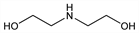
CAS number: 111-42-2
2,2′-Iminobisethanol; 2,2′-iminodiethanol; diethylolamine; bis(hydroxyethyl)amine; 2,2′-dihydroxydiethylamine.
C
4H
11NO
2; mol wt 105.14.
C 45.69%, H 10.55%, N 13.32%, O 30.43%.
Description and references
Produced along with mono- and triethanolamine
by ammonolysis of ethylene oxide. See refs under Ethanolamine. Toxicity study:
H. F. Smyth et al., J. Ind. Hyg.
Toxicol. 23, 259 (1941).
Properties
Deliquescent prisms, mp 28°. Usually offered as a viscous liquid.
Mild ammoniacal odor. d25 1.094019; d430 1.0881; d460 1.0693. One U.S. gallon weighs 9.09 lbs at 30°. Viscosity at 30°:
351.9 cP; at 60°: 53.85 cP. bp760 268.8°; bp150 217°; bp0.01 20°. Strong base: pH of 0.1N aq soln: 11.0. nD30 1.4753. Dipole
moment 2.81. Flash pt 300°F. Miscible with water, methanol, acetone.
Soly at 25° in benzene: 4.2%, in ether: 0.8%, in carbon tetrachloride:
<0.1%, in n-heptane: <0.1%. LD50 orally in rats: 12.76 g/kg (Smyth).Caution
Potential symptoms of overexposure
are irritation of eyes, skin, nose and throat; eye and skin burns,
corneal necrosis; lacrimation, cough, sneezing. See NIOSH Pocket Guide to Chemical Hazards (DHHS/NIOSH
97-140, 1997) p 104.Use
To scrub gases as indicated under ethanolamine.
Diethanolamine can be used with cracking gases and coal or oil gases
which contain carbonyl sulfide that would react with monoethanolamine.
As rubber chemicals intermediate. In the manuf of surface active
agents used in textile specialties, herbicides, petr demulsifiers.
As emulsifier and dispersing agent in various agricultural chemicals,
cosmetics, and pharmaceuticals. In the production of lubricants for
the textile industry. As humectant and softening agent. In buffer
formulations. In organic syntheses.