3364. Disulfiram
Nomenclature
CAS number: 97-77-8
Tetraethylthioperoxydicarbonic diamide; bis(diethylthiocarbamoyl) disulfide; tetraethylthiuram disulfide; bis(diethylthiocarbamyl) disulfide; teturamin; TTD; Antabuse (Odyssey); Esperal (Sanofi-Synthelabo); Etabus (Ferring). C10H20N2S4; mol wt 296.54.
C 40.50%, H 6.80%, N 9.45%, S 43.25%.
Description and references
Prepn: Bailey, US 1796977 (1931 to Roessler and Hasslacher); Adams, Newser, US 1782111 (1931 to Naugatuck); cf. Cummings, Simmons, Ind. Eng. Chem. 20, 1173 (1928). Toxicity study: Child, Cramp, Acta Pharmacol. Toxicol. 8, 305 (1952). Comprehensive description: N. G. Nash, R. D. Daley, Anal. Profiles Drug Subs. 4, 168-191 (1975).
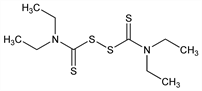
Properties
Crystals, mp 70°. d 1.30. Practically insol in water (0.02 g/100 ml). Sol in alcohol (3.82 g/100 ml), in ether (7.14 g/100 ml), also sol in acetone, benzene, chloroform, carbon disulfide. LD50 orally in rats: 8.6 g/kg (Child, Cramp).Caution
Potential symptoms of overexposure are irritation of eyes, skin, respiratory system; sensitization dermatitis; lassitude, fatigue, tremor, restlessness, headache, dizziness; metallic taste, peripheral neuropathy; liver damage. Ingestion of alcohol after disulfiram administration causes intense vasodilation and flushing of face and neck, restlessness, anxiety; tachycardia and tachypnea; headache, nausea, vomiting, hyperpnea, chest pains, sweating, pallor, hypotension. See NIOSH Pocket Guide to Chemical Hazards (DHHS/NIOSH 97-140, 1997) p 122; Clinical Toxicology of Commercial Products, R. E. Gosselin et al., Eds. (Williams & Wilkins, Baltimore, 5th ed., 1984) Section III, pp 159-163, 383-386.Use
Rubber accelerator; vulcanizer; seed disinfectant; fungicide.Therapeutic Category
Alcohol deterrent.
Keywords
Alcohol Dependence Treatment