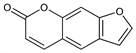
7928. Psoralen
Nomenclature
Description and references
One of a group of furocoumarins occurring naturally in more than two dozen plant sources, including Rutaceae (e.g. bergamot, limes, cloves), Umbelliferae (e.g. celery, parsnips), Leguminosae (e.g. Psoralen coryfolia), and Moraceae (e.g. figs). Isoln: H. S. Jois et al., J. Indian Chem. Soc. 10, 41 (1933); A. Stoll et al., Helv. Chim. Acta 33, 1637 (1950); F. E. King et al., J. Chem. Soc. 1954, 1392. Synthesis: E. Sp"ath et al., Ber. 69, 1087 (1936); R. C. Esse, B. E. Christensen, J. Org. Chem. 25, 1565 (1960); O. Dann, D. Volz, Arch. Pharm. 308, 121 (1975); V. K. Ahluwalia et al., Monatsh. Chem. 111, 877 (1980). Psoralens are phytoalexins; they are used by plants in a defensive response to attacks by fungi and insects: M. Berenbaum, P. Feeny, Science 212, 927 (1981). They have also shown photosensitizing and phototoxic effects in animals and humans and have been used in photochemotherapy for management of vitiligo, psoriasis, and mycosis fungoides, cf. T. F. Anderson, J. J. Voorhees, Annu. Rev. Pharmacol. Toxicol. 20, 235 (1980); A. Kornhauser et al., Science 217, 733 (1982). Review of psoralen photochemistry: B. J. Parsons, Photochem. Photobiol. 32, 813-821 (1980). Review of genetic toxicity of psoralen and uv radiation in human cells: Acta Derm. Venereol. Suppl. 104, 4-40 (1982). See Methoxsalen, Trioxsalen, Bergapten for additional refs.