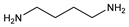
7947. Putrescine
Nomenclature
Description and references
Biogenic polyamine and precursor of spermidine, q.v., initially detected in decaying animal tissues, but now known to be present in all cells and certain bacterial cultures. It is essential for both normal and neoplastic tissue growth. Formed via decarboxylation of ornithine or by decarboxylation of arginine, followed by hydrolysis. Prepn: A. Ladenburg, Ber. 19, 780 (1886); G. Ciamician, C. U. Zanetti, ibid. 22, 1970 (1889); R. Willst"atter, W. Heubner, ibid. 40, 3871 (1907); of the dihydrochloride: Org. Synth. coll. vol. IV (1963) p 819. Role in cell growth processes: C. W. Tabor, H. Tabor, Annu. Rev. Biochem. 45, 285 (1976); J. Janne et al., Biochim. Biophys. Acta 473, 241 (1978). Formation and interconversion of putrescine and spermidine in mammalian cells: A. E. Pegg et al., Adv. Enzyme Regul. 19, 427 (1980). Biosynthetic study in fungi: L. Stevens, Med. Biol. 59, 308 (1981). Regulation of tRNA methyl transferase activity: M. Mach et al., Biochem. J. 202, 153 (1982). Alteration of DNA conformation in rat brain tumor cells by depletion of intracellular putrescine: D. T. Hung et al., Science 221, 368 (1983). Use of labeled putrescine as a positron-emission tomographic tracer in brain tumors: N. Volkow et al., ibid. 673. Reviews of early literature: M. Guggenheim, Die biogenen Amine (S. Karger, Basel, 1951, 4th ed.) 619 pp; H. Tabor et al., Annu. Rev. Biochem. 30, 579-604 (1961). Review of formation of GABA, the major inhibitory neurotransmitter in vertebrate brains, from putrescine: N. Seiler, Physiol. Chem. Phys. 12, 411-429 (1980). Review of metabolism: T. L. Sourkes, K. Missala, Agents Actions 11, 20-27 (1981). Book: Polyamines in Biology and Medicine, D. R. Morris, L. J. Marton, Eds. (Dekker, New York, 1981) 512 pp.