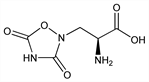
8085. Quisqualic Acid
Nomenclature
Description and references
Excitatory amino acid (EAA) used to identify a specific subset of EAA receptors; consequently, the receptors are known as quisqualate receptors. See also NMDA, kainic acid. Isoln from the seeds of Quisqualis chinesis and anthelmintic activity: Y.-C. Tuan et al., Yao Hsueh Hsueh Pao 5, 87 (1957), C.A. 56, 14896b (1958); from Q. indica: S.-T. Fang, J.-H. Chu, Hua Hsueh Hsueh Pao 30, 226 (1964), C.A. 61, 7359f (1962); from Q. fructus: T. Takemoto et al., Yakugaku Zasshi 95, 176 (1975), C.A. 82, 152211a (1975). Enzymic synthesis: I. Murakoshi et al., Chem. Pharm. Bull. 22, 473 (1974). Total synthesis: J. E. Baldwin et al., Chem. Commun. 1985, 256. Crystal structure: J. L. Flippen, R. D. Gilardi, Acta Crystallogr. B32, 951 (1976). Identification as a neuroexcitant: H. Shinozaki, I. Shibuya, Neuropharmacology 13, 665 (1974). Receptor binding studies: K. Koshiya, Life Sci. 37, 1373 (1985); J. T. Greenamyre, J. Pharmacol. Exp. Ther. 233, 254 (1985). Review of isolation of quisqualic acid and other EAAs: T. Takemoto, in Kainic Acid as a Tool in Neurobiology, R. G. McGeer et al., Eds. (Raven Press, New York, 1978) pp 1-15.